Prevention
The CDC suggests that the following measures may reduce your risk of naegleria infection:
- Don't swim in or jump into warm freshwater lakes and rivers.
- Hold your nose shut or use nose clips when jumping or diving into warm bodies of fresh water.
- Avoid disturbing the sediment while swimming in shallow, warm fresh waters.
Diagnosis
Imaging tests
-
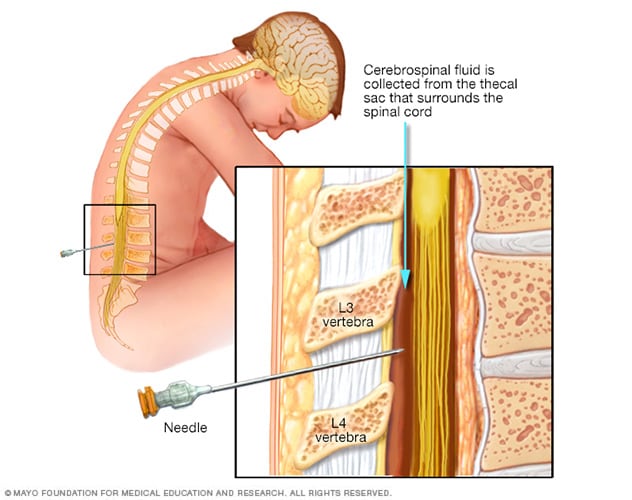
Spinal tap
(lumbar
puncture)
Computerized tomography (CT) or magnetic resonance imaging (MRI) can reveal swelling and bleeding within the brain.
- CT scan. This procedure combines X-ray views taken from many different directions into detailed cross-sectional images.
- MRI. An MRI machine uses radio waves and a strong magnetic field to produce extremely detailed images of soft tissues, such as the brain.
Spinal tap (lumbar puncture)
Naegleria amoeba can be seen under a microscope in the fluid that surrounds your brain and spinal cord. The spinal fluid is obtained by inserting a needle between two vertebrae in your lower back. This test also can measure the cerebral spinal fluid pressure and look for inflammatory cells.
TREATMENT.
Comments